

Welcome to The Newsie Chronicles — a serialized cozy cat mystery about feral cats, river legends, and one brown tabby who chose her humans. Set in Mattox’s Landing, New Jersey, along Prince’s River. Based on true cats. New chapters are free to read, with a new installment every two weeks.
The Newsie Chronicles — series home
🎧 Read with the river: press play on the 10-minute dusk-porch ambience below while you read.
Chapter 1: The Screen Door
Chapter 1: The Screen Door
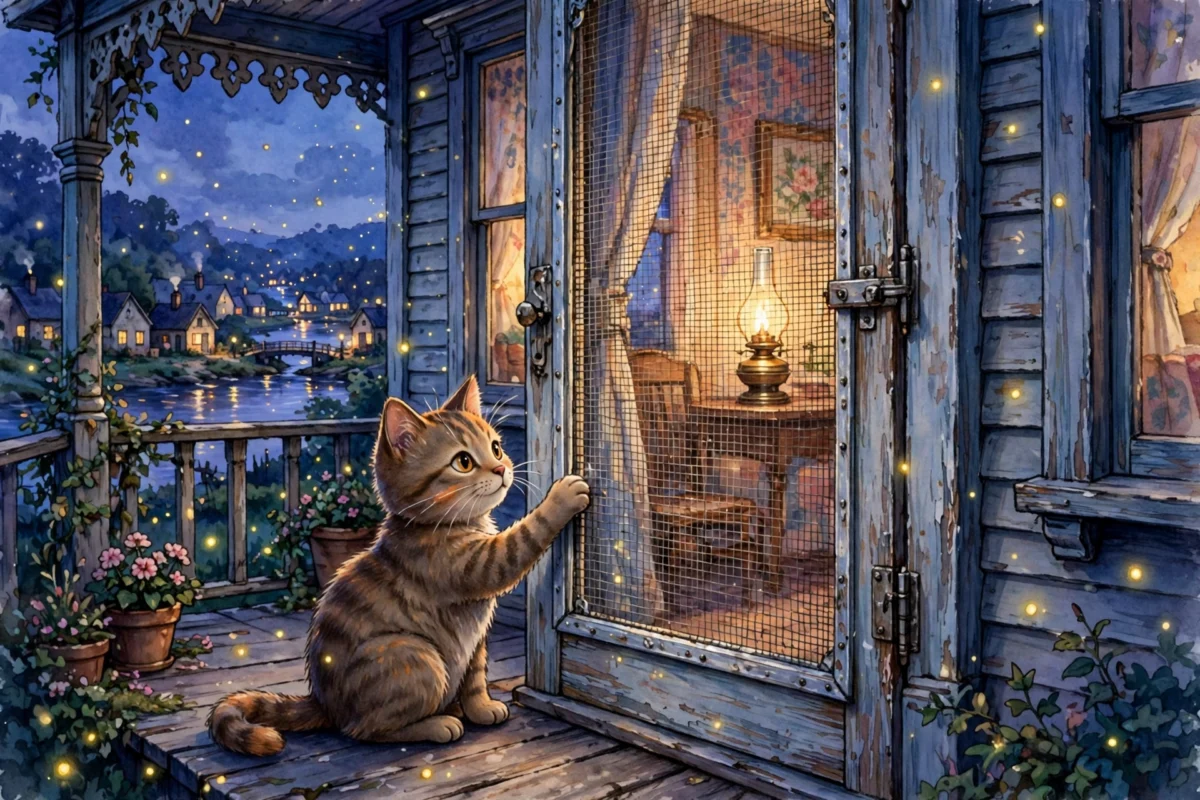
The screen door had been there longer than anybody could remember, which in Mattox’s Landing meant longer than anybody would admit to forgetting. Its wooden frame had gone silver with age, and the mesh sagged in the middle where a thousand paws — raccoon, opossum, cat — had pressed their curiosity against it over the decades. The Victorians on the river side all had one. It was the kind of door that didn’t keep anything out so much as declare a border: on this side, the wild; on that side, supper.
Newsie sat on the supper side, which was the whole problem.
Dusk was coming down over the Prince’s River in layers — first the gold going off the water, then the blue settling into the marsh grass, then the particular gray-violet that meant the mosquitoes were clocking in. Through the mesh, the evening arrived in pieces: the iron smell of the river at low tide, fried onions from somebody’s kitchen three houses down, the distant clank of a halyard against a mast where the boats slept at the town dock.
On her side of the door: tuna water in a clean bowl, a folded quilt that smelled like sunshine, and the man in the armchair, snoring softly over his newspaper with all the trust of a creature that had never once been hungry in winter.
Newsie put one paw against the screen and felt the evening push back.
She had not been caught, and this was the thing nobody in the colony could forgive or understand. Cats got caught. It happened every spring — the box with the miraculous chicken inside, the clang, the ride, the indignity of the warm room. But no one had caught Newsie.
She had arrived.
It had been late summer. Raphana was alone on the back deck, watching the light go silver on Prince’s River — the Wild and Scenic Prince’s River, federally protected, the river running clean past the town the way it had for two hundred years — when something small and striped materialized beside her feet and cried out. Not a yowl. A soft, raspy little kitten-cry, the kind that bypasses the ears entirely and goes straight for the heart.
The man came home to find his wife on the deck with an eight-month-old tabby in her lap, and it was, as he would tell it for the rest of his life, love at first meow.
They had nothing to feed her. Nothing. Raphana produced, from the depths of her bag, a turkey Lunchables — and the little tabby ate a piece of cold-cut turkey as if it were a wedding feast. The next morning they ran to the local store and came home with Sheba, and Newsie ate it straight out of the cup while the two humans hovered like nervous waiters — first-time cat caretakers who didn’t know the first thing about bowls or portions or serving, only that this small creature had to know one thing: we are here for you.
She came back the next day. And the next. Three times a day, for food and for company, all through the fall — until the warm summer night when curiosity finally outweighed caution and she slipped through a tear in the back screen door, into the 1830s Victorian itself. Raphana was out on the deck. The man was in the kitchen. And into the library walked a small brown tabby — brown, though she looked gray from a distance, with faint orange in her fur like embers — looking around in open wonderment, proceeding through the first floor with the deliberate poise of a model on a runway. The man watched from the kitchen doorway as she surveyed, room by room, the lay of the land.
She was looking to move in.
She had chosen.
Two years later, the colony still talked about it the way people talk about a lottery winner — with a blend of awe and faint disgust. Across the street, in the deepening blue, two shapes detached themselves from the hedge and resolved into cats.
“She’s at the door again,” said Tiger Tiger, loudly, to no one in particular, which was how Tiger Tiger said everything.
—
Tiger Tiger was named after a Duran Duran song, a fact she would have found either thrilling or insulting, depending on the hour. She was a tabby gone to stripes in all the wrong places, with a voice like a rusty gate hinge and opinions about everything. Food, primarily. The quality of food. The timeliness of food. The moral character of anyone who was late with food.
“Evening, queen,” said Bootie, settling beside her with the economical grace of a cat who had never wasted a single motion in her life. Bootie’s two back feet were white to the ankle, as if she had stepped in paint as a kitten and decided to keep it. It gave her walk a particular dandified precision, like a duchess picking her way through a puddle.
“Don’t ‘evening, queen’ me,” said Tiger Tiger. “She’s doing it again. Look at her. Paw on the screen like she’s reading a telegram.”
“She’s watching the river.”
“She’s watching us watching her. It’s a whole production.” Tiger Tiger raised her voice half an octave. “SOME OF US ARE OUT HERE IN THE MOSQUITOES.”
From the porch, one brown ear rotated in their direction. That was all.
Bootie tucked her white feet beneath her. “Leave her be. She earned the quilt.”
“She abandoned the patrol.”
“She retired from the patrol. There’s a difference, and you know it because you’re old enough to remember when old Marlow retired and nobody gave him grief.”
“Marlow didn’t have a quilt.” Tiger Tiger stood, shook each paw with theatrical disgust, and began washing her face with the fury of a cat composing a strongly worded letter. “Marlow slept in a boathouse like an honest animal.”
“”Marlow slept in a boathouse because the boathouse had a hole in the roof and he liked the rain,” said Bootie. “And I’ll remind you that before Mindy fished you out of Bridgeton, your own sleeping arrangements were best described — what was the phrase? — as ‘a lady of leisure.’”
Tiger Tiger stopped mid-lick. “That was ONE summer and I was YOUNG.”
“It was a rehabilitation,” said Newsie mildly, from the steps.
“It was a relocation,” said Bootie. “Mindy’s word. ‘Off the streets,’ she said. Like you were in a program.”
“I was in a program! The program was this town!””
“You always take her side.”
“I take the side of whoever’s right, which keeps me very busy, because you’re almost never it.”
Before Tiger Tiger could assemble a reply worthy of the insult, the front door of the faded pea-green house two doors down opened, and Mindy and Tim stepped out into the evening with their walking shoes on.
Tiger Tiger was on her feet before the door finished swinging.
“Oh, here we go,” said Bootie.
—
It was the parade, and the parade was sacred.
Every evening that the weather allowed — and some evenings it merely suggested — Mindy and Tim walked the half mile to the No Man’s Friend Society and back. It was not a long walk. It was not an eventful walk. But for Tiger Tiger, it was the social engagement of the day, and she treated it with the gravity of a state occasion.
She fell in behind them at the garden gate, head high, tail straight up like a flag.
Mindy glanced back. “Tiger Tiger. Go home.”
It was said with love. It was always said with love. It never worked, and it was never meant to.
Tiger Tiger stopped dead. Her ears went back. Her tail, that proud flag, developed a twitch at the very tip — the feline equivalent of a sharp intake of breath. With enormous dignity, she turned around and began walking in the opposite direction.
One. Two. Three steps.
Then she turned around again and resumed following them, slightly faster, as if to make up for lost time.
“She’s doing the thing,” Tim said.
“She’s doing the thing,” Mindy agreed. They walked on. Tiger Tiger walked on behind them, a striped shadow with strong feelings about being told what to do.
Bootie, watching from the hedge, allowed herself one slow blink. “She’ll be insufferable about this for a week.”
“She’s insufferable about everything for a week,” said Newsie, from the porch.
Both cats turned. Newsie had come down the porch steps — on her side of the property line, technically, though the property line was a fiction cats observed only when it suited them — and stood at the bottom with her tail curled around her paws.
“Well,” said Tiger Tiger, arriving at a trot, having apparently decided the parade could continue without her, or that the parade was coming to her, which amounted to the same thing. “The queen descends.”
“Don’t start.”
“I’m not starting. Bootie, am I starting?”
“You’re starting,” said Bootie.
The three of them settled in the familiar triangle — Newsie on the bottom step, Tiger Tiger in the grass, Bootie on the warm brick of the walk — and for a while there was just the evening: the river smells, the first bats stitching the sky, the far-off tonk of a wind chime. This was the ritual. The patrol came to the porch. Newsie came to the edge of the porch. The screen door stood open behind her, the house glowing warm, and nobody mentioned it, the way nobody mentions the tide.
“Marsh cats were at the dock again,” Bootie said at last. “Three of them. Acting like they own the pilings.”
“They don’t own the pilings,” said Tiger Tiger.
“Nobody owns the pilings. That’s the point I made, at length, from the top of the bait shed.”
“What did they want?”
“Same thing everybody wants at the dock.” Bootie glanced toward the river, though the river was hidden by the houses. “To see if it’s true.”
A small silence settled over the triangle.
“If what’s true,” said Newsie.
Tiger Tiger and Bootie exchanged a look — the particular look of cats who have agreed, without discussing it, not to discuss something.
“Nothing,” said Tiger Tiger, too quickly. “Colony gossip. You know how it is. Somebody hears something, everybody hears something, nobody heard anything.”
“Tiger Tiger.”
“What? I’m eating regularly, I’m sleeping fine, the No Man’s Friend Society walk is thriving —”
“Bootie.”
Bootie was quiet for a moment, her white feet glowing faintly in the dusk like two small moons. “There’s been a light,” she said. “On the river. Late. Where the channel bends past the old oyster beds.”
“A boat,” said Newsie.
“No engine,” said Bootie. “That’s the thing. No engine, no running lights like they’re supposed to have. Just — a light, moving. Then gone.”
Tiger Tiger stood abruptly. “It’s nothing. It’s a reflection. It’s the moon on a buoy. It’s —”
“It’s the third night in a row,” said Bootie.
From the hedge across the street, something moved — not a rustle, exactly, but the absence of a rustle, the shape of a silence walking. The three cats went still.
Black Panther emerged into the blue dusk like ink spreading in water.
—
Nobody knew if Black Panther was a boy or a girl, and Black Panther preferred it that way. The cat was all shadow and intention, with eyes like two struck matches, and moved through Mattox’s Landing the way rumors move through a small town — everywhere, unconfirmable, slightly ahead of you.
“Evening, colony,” said Black Panther, in a voice like velvet dragged over gravel.
“Evening,” said Bootie, carefully.
Tiger Tiger said nothing, which for Tiger Tiger was the equivalent of a scream.
Black Panther settled at the edge of the triangle without being invited, which was also the way rumors behaved. Those match-struck eyes found Newsie on the step.
“Heard you were asking about the river,” said Black Panther.
“I asked one question.”
“One’s enough.” A pause. “You want to know what I think it is?”
“Not particularly,” said Tiger Tiger.
“I think it’s the nightboat,” said Black Panther.
“The what,” said Newsie.
Black Panther’s gaze drifted toward the dark where the river ran, invisible but present, the way history is present in a town like Mattox’s Landing — under everything, holding everything up.
“They say this river used to carry more than oysters,” Black Panther said softly. “They say the schooners ran dark in those days. No lights. No names. Just the tide and the cargo and men who knew the channel by heart.” The match-struck eyes came back to Newsie. “They say some cargoes never got delivered. They say on certain nights, the delivery’s still trying to make it.”
“That’s a ghost story,” said Bootie, but her voice had gone thin.
“Everything’s a ghost story until the third night in a row.” Black Panther rose, all fluid shadow. “Halloween’s coming, colony. Eight days. The veil gets thin, the river gets talkative.” A beat. “I’ll be at the dock at midnight. To watch. Anybody who wants to know — really know — can come see for themselves.”
And then the dark between the houses folded shut, and Black Panther was gone, the way a rumor goes — not ending, just moving somewhere you’d have to follow to hear the rest.
The three cats sat in the ringing silence.
Tiger Tiger found her voice first. “Well. That’s — that’s obviously —” She stopped. Started again. “It’s probably nothing.”
But Bootie was looking at Newsie, and Newsie was looking past them both, past the hedge, past the sleeping houses, toward the black ribbon of the Prince’s River — where, for just a moment, at the bend past the old oyster beds, a single light moved against the dark.
And went out.
—
TO BE CONTINUED…
Continue the story: Chapter 2: “Waiting for the Nightboat” is available to read free.
To be continued…
What happens next?
Continue with Chapter 2: “Waiting for the Nightboat”, now available to read free.
📥 Want Chapter 1 as a free PDF keepsake? Download it free in the shop.
